$3,192 a car in incentives is missing from your automotive CAC
Most automotive marketers quote the $739 dealers spend on advertising per new vehicle as their acquisition cost, but that figure covers only part of what it takes to win a car buyer. This explainer shows how to add co-op, incentives, floorplan support and lead-vendor fees into one acquisition cost without counting anything twice.
 Ada BrandtBrand & Marketing StrategistOctober 12, 2026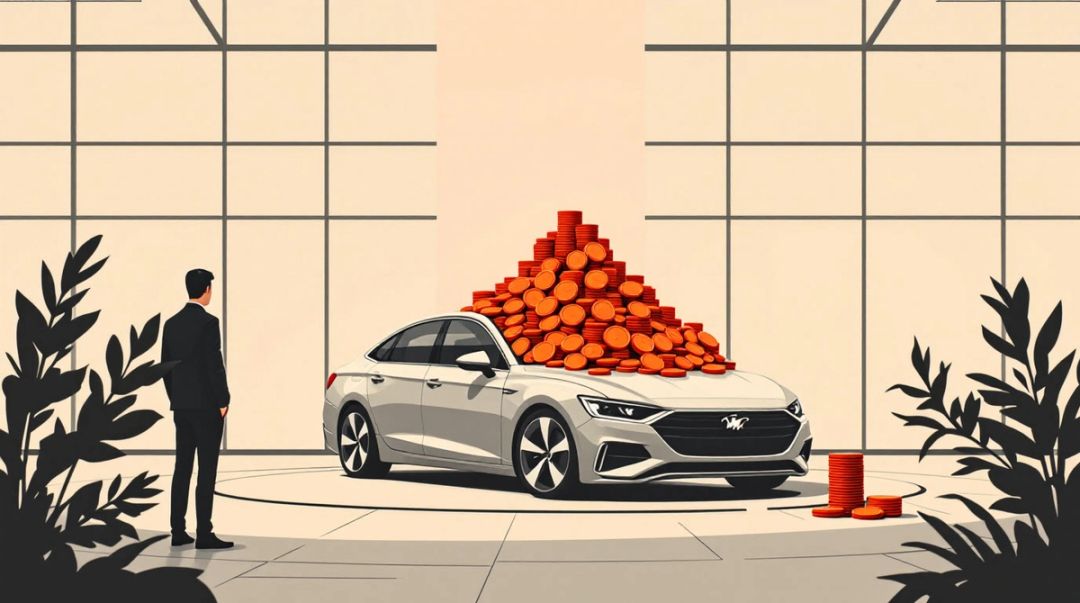
Listen to the podcast
10 min
Chapters
Key takeaways
- Book dealer advertising net of co-op reimbursement and keep co-op on the OEM marketing line so each dollar is counted once.
- Do not add portal subscriptions on top of advertising, but find TrueCar per-sale fees booked as cost of sale and add them in.
- Leave floorplan assistance out of CAC unless it funds a discount or an aged-unit cash program.
- Never show the blended CAC to a CFO without the incremental cost per sale from a holdout test next to it, presented as a range.
- On Monday, ask finance for last quarter's incentive spend by nameplate and region and put it on one page next to media spend.
Read the full transcript
Host:MBA Training. Ten minutes on $3,192 a car in incentives is missing from your automotive CAC.
Expert:Picture a conference room in a dealer group's head office, Tuesday morning. The marketing director has a slide that says cost per sale: seven hundred thirty-nine dollars. The CFO leans over and asks where the rebates are. Silence. Nobody in that room had ever put the hood money and the media money on the same page.
Host:And that silence is this episode. The article we're working from is titled "$3,192 a car in incentives is missing from your automotive CAC." CAC is customer acquisition cost, what you spend to win one buyer. My guest is a chief marketing officer who has sat in that room more than once. Let's start with the seven-thirty-nine. Where does it come from?
Expert:NADA, the National Automobile Dealers Association. Their average dealer spent $739 on advertising for each new vehicle sold last year. It's a clean number and easy to benchmark, which is exactly why everybody quotes it. It's also wrong by a factor of about five.
Host:That's a big claim.
Expert:Cox Automotive reports incentive spending of $3,192 per vehicle in July 2026. That's 6.4% of ATP, the average transaction price, what people actually pay. Quick caveat: Cox owns Autotrader and Kelley Blue Book and sells to dealers, so they have a stake in the channel. Still, incentives come out to more than four times dealer advertising per unit, and almost no marketing deck includes them.
Host:Why not? Nobody's hiding rebates.
Expert:They aren't hidden, they're just scattered. The OEM, the original equipment manufacturer, meaning Ford or Toyota, books incentives as contra-revenue, a deduction from sales rather than a marketing expense. The incentive budget belongs to sales and finance. The OEM's CMO, the chief marketing officer, runs national media. The dealer group CMO sees advertising per unit. Each person optimizes their own slice, and nobody adds them up.
Host:Zoom out for me. Strip away cars. What's the principle?
Expert:Every dollar the value chain spends to win a sale gets counted once, on the ledger of whoever actually pays it, and divided by the sales those dollars caused. That holds whether you sell trucks or software. The best operators learned it the hard way: a cost doesn't become free because it sits in somebody else's department.
Host:Fine, but car margins have been fat for years. Does a fuzzy number really hurt anyone?
Expert:Those years are over. Dealer benchmarking across more than 4,000 franchised stores shows new-vehicle gross profit down 13.5% year over year to $1,840 per unit in Q2 2026, the second quarter. Sonic Automotive's 10-Q, their quarterly filing with the SEC, the Securities and Exchange Commission, shows retail new gross per unit down $559, or 16%, to $2,872. When front-end profit is that thin, a misallocated acquisition dollar comes straight out of net.
Host:Let's get into the mechanics. Co-op first, and define it.
Expert:Co-op is cooperative advertising money. The OEM accrues a fund per vehicle sold, and the dealer usually has to match it. That description comes from Brandmovers, an agency that designs these programs. Stackmatix, which sells co-op management, claims co-op can cover 50 to 100% of digital spend on new-vehicle campaigns. They sell the service, so check that against your own reimbursement history before you believe it.
Host:And where does the counting go wrong?
Expert:In two opposite directions. The dealer reports gross advertising, the OEM reports the co-op payout as marketing, and the same dollar shows up twice. Or the dealer reports net, the OEM files co-op under "dealer programs," and the dollar disappears. The fix is boring. Dealer advertising goes in net of reimbursement, and co-op sits on the OEM marketing line.
Host:Boring fixes rarely get done. Is there pressure to do this one now?
Expert:Yossi Levi, founder of Car Dealership Guy, predicts dealers will start opting out of OEM co-op "en masse" over the next two years. If he's right, spend migrates from the OEM line to the dealer line. Total acquisition cost doesn't move, but every siloed report will show a story. Only the fully loaded view shows that nothing actually changed.
Host:Portals. Cars.com, CarGurus, TrueCar. Add them on top?
Expert:Usually no, and that's the most common double count I see. Third-party websites are about 20% of NADA's dealer budget, so roughly $148 of the $739 already goes to portals. Subscriptions sit inside advertising: Cars.com reports monthly average revenue per dealer of $2,500, and CarGurus reports quarterly average revenue per subscribing dealer of $8,134. Both numbers come from the vendors' own filings. TrueCar is different. It charges a fee per car sold, and stores often book that as a cost of sale, outside advertising. Go find those fees and add them in.
Host:There's a shift hiding in the Cars.com numbers, isn't there?
Expert:OEM and national revenue fell 18% to $13.6 million in Q2 2026, while revenue per dealer rose 3%. Manufacturers are pulling back from portals and dealers are paying more. A model that only covers the OEM side records that as a saving, when the cost has just moved to another ledger.
Host:Floorplan. My listeners' eyes are glazing over already.
Expert:Then keep it short. Floorplan is the loan dealers use to carry inventory, often from the captive lender, Ford Motor Credit, GM Financial, Toyota Financial Services. OEMs pay much of the interest back as floorplan assistance. Group 1 Automotive had $23.3 million of floorplan interest in Q1 2026, less $20.1 million of assistance, for a net of $3.2 million. AutoNation books assistance inside new-vehicle gross profit. My rule is to leave it out of CAC, because it pays for inventory, not customers.
Host:Always?
Expert:Unless it funds a discount. If a store passes a free-flooring period through as a price cut, or an aged-unit cash program fires to clear the lot, that money is buying a customer, and it goes in.
Host:Walk me through one store, with real arithmetic.
Expert:It's a hypothetical, using sourced averages plus a made-up co-op rate and test result. Take 100 retail units. Advertising at $739 comes to $73,900. Say 30% is reimbursed by co-op: $22,170 goes to the OEM line, and the dealer's net is $51,730. Incentives at $3,192 come to $319,200. The wrong method double-counts co-op and shows media at $961 a unit. Counted once, media is $739. Fully loaded blended CAC is $3,931 a unit.
Host:Which makes marketing look five times more expensive. Thanks for that.
Expert:It gets worse before it gets useful. Suppose a holdout test, where you withhold the incentive in a comparable region, shows the incentive caused only 15 of those 100 sales. Its cost per incremental sale is $319,200 divided by 15, or $21,280. Set that against $1,840 of new gross plus F&I, finance and insurance income, at an all-time high of $1,769, about $3,609 per unit. That incentive only pays back through service, repurchase, or inventory relief. If search can buy an incremental sale for less, the next dollar should go to search.
Host:That's where it gets uncomfortable. Hand a CFO $3,931 and they'll cut your media budget first.
Expert:That's the real political risk, so never show the blended number without the incremental one next to it. There are other traps too. Holdouts are noisy, so present a range. Some rebates simply offset a tariff-driven MSRP increase, MSRP being the manufacturer's suggested retail price. That's pricing, not marketing. And in March 2026 the FTC, the Federal Trade Commission, sent warning letters to 97 dealer groups, so incentive-led ads carry legal exposure no CAC figure captures.
Host:Does the store GM need any of this for weekly decisions?
Expert:No, it's too slow for that. Week to week, you want clean cost per car sold. Frank Esparza at Tracy Honda used GA4, Google Analytics 4, along with UTM tags, the tracking codes on links, and found budget they couldn't tie to any sale. That's the right level of rigor for weekly pacing. Fully loaded CAC is for the big calls: the annual split between incentives and media, EV launches where electric-vehicle incentives hit 12% of ATP in August, staying in co-op, and portal renewals.
Host:And if incentive discipline cracks?
Expert:Cox's senior economist noted that before covid, in the 17-million-unit sales years, incentives were around 10 or 11% of transaction price. Tariffs forced restraint. If that restraint weakens, incentives become the fastest-growing acquisition cost in the business, and a CMO still quoting $739 won't even see it coming.
Host:Give me one thing to do on Monday.
Expert:Ask finance for last quarter's incentive spend by nameplate and region, booked as contra-revenue, and put it on one page next to your media spend. Just one page, both numbers. The argument about where the next dollar goes starts from there.
Host:Sources: Insideradio, Cox Automotive Inc. and Digitaldealer. Every link is in the show notes. Done for today. There's a new CMO piece every morning at mba-training.com.
Ask an automotive marketer what it costs to acquire a new-car buyer and you will usually get one number. According to NADA, the average dealer spent $739 on advertising for each new vehicle sold last year. The number is clean and easy to benchmark. It also understates true customer acquisition costcustomer acquisition costCustomer Acquisition Cost (CAC) is the total sales and marketing spend divided by the number of new customers gained in a period. It measures how efficiently you grow.View full definition → several times over, because most of the money spent to win a car buyer never reaches the advertising line. Cox Automotive (which owns Autotrader and Kelley Blue Book and sells to dealers, so it has a stake in the channel) reports that incentive spending fell to $3,192 per vehicle, or 6.4% of ATP in July 2026. That money sits in contra-revenue at the OEM. Floorplan assistance is booked inside new-vehicle gross. Depending on whose ledger you read, OEM co-op is counted twice or not at all.
The thesis of this piece: true automotive CACCACCustomer Acquisition Cost (CAC) is the total sales and marketing spend divided by the number of new customers gained in a period. It measures how efficiently you grow.View full definition → is every dollar the value chain spends to win a retail sale, counted once on the ledger of whoever pays it, and divided by the sales those dollars actually caused. Calculated that way, incentives are the biggest acquisition costacquisition costCustomer Acquisition Cost (CAC) is the total sales and marketing spend divided by the number of new customers gained in a period. It measures how efficiently you grow.View full definition → in most franchises. The most important allocation decision a CMO influences is how much goes on the hood versus into media, and a CAC that stops at $739 can't inform that decision.
Why dealer cost per sale misleads automotive CMOs
Every budget owner sees one slice. The OEM CMO runs national and regional media and usually writes the co-op guidelines. The incentive budget belongs to sales and finance. The dealer group CMO sees advertising per unit. Nobody adds the slices together, so each one gets optimized on its own.
Look at the scale. According to NADA data reported by Inside Radio, the average dealership advertising spendadvertising spendAny media you pay for: display ads, search ads, social ads, and sponsorships. You buy access to someone else's audience on a per-click, per-impression, or flat-fee basis.View full definition → in 2025 was $586,246, up 7.8% over 2024, and the largest shares of the 2025 advertising budget were allocated to search engine marketingsearch engine marketingSearch Engine Marketing: reaching audiences through search engines, combining organic SEO and paid search (SEA) to capture user intent at the moment of search.View full definition → (21.1%), third-party websites (20.0%), and search engine optimizationsearch engine optimizationSearch Engine Optimization: the practice of improving your pages' natural (unpaid) rankings in search engine results pages to attract more organic traffic.View full definition → (19.5%). At $3,192 per unit, incentives are more than four times dealer advertising per unit.
Margins make the gap expensive. Dealer benchmarking data covering more than 4,000 franchised stores shows new vehicle gross profit fell 13.5% year-over-year to $1,840 per unit in Q2 2026. Sonic Automotive's 10-Q says retail new vehicle gross profit per unit decreased $559, or 16%, to $2,872 per unit in the same quarter. With front-end gross that thin, every misallocated acquisition dollar comes straight out of net profit.
Costs are also moving between parties. In Q2 2026, Cars.com reported OEM and National revenue of $13.6 million was down 18% year-over-year, while Monthly Average Revenue Per Dealer increased to $2,500 (up 3% year-over-year). OEMs are pulling back from portal advertising and dealers are paying more for marketplace exposure. A CAC model that only covers the OEM side records that shift as a saving.
The incentive line could also grow quickly. Cox's senior economist noted that prior to covid, during the 17+ million sales years, incentives were closer to 10 or 11% of the transaction price. Today's restraint reflects the fact that in the wake of tariffs, and their squeeze on profitability, it appears that more pricing discipline is the new path forward. If that discipline weakens, incentives become the fastest-growing acquisition cost in the business.
How do you load co-op, incentives and floorplan into automotive CAC?
Put each cost on the ledger of the party that ultimately pays it, remove reimbursements so nothing is counted twice, and keep money that wins customers separate from money that carries inventory. Four cost streams need specific treatment.
Co-op: count it once, at the OEM
According to Brandmovers, an agency that designs dealer incentive programs, a typical program works like this: the OEM commits a per-vehicle co-op fund accrual for each vehicle sold, and most programs require a dealer matching contribution. Stackmatix, an agency that sells co-op management, claims co-op can cover 50 to 100% of your digital ad spend on new vehicle campaigns. That is a vendor estimate, so check it against your own reimbursement history.
The trap is in the reporting. If the dealer reports gross advertising and the OEM also reports co-op payouts as marketing, the same dollar appears twice. If the dealer reports net spend and the OEM files co-op under "dealer programs," the dollar disappears. The fix is to count dealer advertising net of reimbursement and put co-op on the OEM marketing line.
This matters more now. Car Dealership Guy founder Yossi Levi predicts dealers will begin opting out of OEM co-op programs "en masse" during the next two years. If he is right, spend moves from the OEM line to the dealer line and total acquisition cost stays the same. Only a fully loaded view shows that nothing actually changed.
Lead-vendor fees: check whether they are already in the $739
Third-party websites make up 20% of NADA's dealer budget, so roughly $148 of the $739 already goes to portals. Subscriptions such as Cars.com's $2,500 monthly ARPD and CarGurus' U.S. QARSD of $8,134 per quarter (both figures from the vendors' own filings) sit inside advertising. Adding them again is the most common double count in dealer CAC decks. Per-sale fees work differently. TrueCar charges each participating dealer a fee for every car sold through TrueCar, and stores often book that fee as a selling expense or cost of sale, outside advertising. Find those fees and add them.
Incentives: load all of it, then divide by what it caused
Incentive intensity varies widely by segment. In July, Cox found spending elevated in many of the best-selling segmentssegmentsDividing a market into distinct groups of customers who share similar needs, characteristics or behaviours, so each group can be served with a tailored approach.View full definition →, including full-size pickup trucks (8.6%), compact SUVs (7.8%) and mid-size SUVs (6.8%). For EVs, EV incentive spending averaged 12% of ATP in August. For the P&L view, divide all incentive dollars by all units. To choose between levers, divide by the units the incentive caused. That requiresmeasuring which incentive dollars are incremental, usually through regional holdouts or matched-market tests.
Floorplan support: inventory money until it funds a discount
When a new vehicle arrives, the floorplan lender (often the manufacturer's captive finance company, Ford Motor Credit, GMGMGross margin is the share of revenue left after subtracting the direct cost of producing goods or services, expressed as a percentage of revenue.View full definition → Financial, Toyota Financial Services, or a bank) pays the manufacturer, and the dealership owes the floorplan lender. OEMs then pay much of that interest back. In the first quarter of 2026, Group 1 Automotive reported floorplan interest expense of $23.3 million, less floorplan assistance of $20.1 million, for net floorplan expense of $3.2 million. AutoNation explains that floorplan assistance is based on a percentage of the manufacturer's suggested retail price or a flat rate per vehicle and is accounted for as a component of new vehicle gross profit. It reported $33.9 million of assistance against $42.0 million of interest in Q2 2026.
By default, floorplan assistance is a margin transfer through wholesale pricing, and it pays for inventory, not customers. Leave it out of CAC. Add it in only when a store passes assistance or a free-flooring period through as a price cut, or when an aged-unit cash program kicks in to clear a lot. Understandinghow floorplan assistance flows through dealer gross tells you which of those situations you're in.
A worked example on 100 retail units
The example below is hypothetical and arithmetic only. It uses sourced per-unit averages and an invented co-op rate and test result.
- Dealer advertising at NADA's average: 100 × $739 = $73,900.
- Assume 30% is reimbursed through co-op: $22,170 goes on the OEM line and the dealer's net spend is $51,730.
- Incentives at Cox's July average: 100 × $3,192 = $319,200.
Wrong method: the dealer reports $73,900 and the OEM also reports $22,170, so media looks like $961 per unit. Counted once, media is $739 per unit. Fully loaded blended CAC is ($73,900 + $319,200) ÷ 100 = $3,931 per unit.
Now suppose a holdout test shows the incentive caused 15 of the 100 sales. The incentive's cost per incremental sale is $319,200 ÷ 15 = $21,280. Compare that with $1,840 of new-vehicle gross plus finance and insurance income at an all-time high of $1,769 per vehicle retailed, about $3,609 per unit. On those numbers, the incentive only pays back through service and repurchase value, or through inventory relief. If search or portals can buy an incremental sale for less, the next dollar should go there.
The rule for the whiteboard
Count every dollar once, on the ledger that pays it. Report blended CAC as all dollars over all units. Compare levers using each lever's dollars over the incremental units it caused. Floorplan money stays out until it funds a discount.
When fully loaded automotive CAC helps and when it misleads
Use it for the big allocation calls: the annual split between incentives and media, EV launch budgets where incentives run at nearly double the industry rate, decisions on whether to stay in co-op, and portal contract renewals. Those are the decisions where a $739 frame and a $3,931 frame lead to different answers.
It misleads in four situations.
First, incrementalityincrementalityThe share of results (sales, conversions, revenue) that only happened because of a marketing action, not what would have occurred anyway.View full definition → estimates are noisy. A single holdout in one region can be off by a lot, so present a range and avoid quoting false precision.
Second, it is too slow for store-level pacing. Monthly management needs cost per car sold, tracked properly. At Tracy Honda, general manager Frank Esparza found a certain amount of budget on marketing that we really can't attribute to a sale by checking GA4 and UTM data. That is the right level of rigor for weekly decisions.
Third, some "incentives" are really price corrections. Cox notes that automakers beginning to pass along tariff costs should not be underestimated. A rebate that only offsets a tariff-driven MSRP increase belongs to pricing, and loading it into CAC makes marketing look worse without helping any decision.
Fourth, there are politics and compliance. A finance team handed $3,931 without the incremental view may cut media first. On compliance, in March 2026, the FTC sent warning letters to 97 dealer groups, so incentive-led advertising carries legal exposure that a CAC figure doesn't capture.
What to do on monday
- Ask finance for last quarter's incentive spend by nameplate and region, booked as contra-revenue, and put it next to your media spend on one page.
- Pull co-op payouts from the OEM ledger and compare them with what your top dealer groups report as gross advertising. If both include the reimbursement, you have found your double count.
- Check where TrueCar and other per-sale lead fees are booked in your largest stores' financial statements, and move them into CAC if they sit outside advertising.
- Split floorplan assistance into "carried inventory" and "funded a discount," using aged-unit and stair-step program data from the last two quarters.
- Pick one incentive program and propose a two-region holdout for next month, so your next allocation meeting has an incremental number.
Most automotive CAC decks get two things wrong: they include co-op twice and incentives not at all. Fixing both usually moves the per-unit figure from a few hundred dollars to a few thousand. With that number, you can argue for where the next dollar of acquisition money should go.
The full course on this sector:Marketing in Automotive.
Frequently asked questions
What is the average advertising cost per new car sold at US dealerships?
NADA reports that franchised dealers spent an average of $739 on advertising for each new vehicle sold in 2025, out of an average total ad budget of $586,246. About 20% of that budget goes to third-party websites, so portal subscriptions are already included in the $739 and shouldn't be added again.
Should manufacturer incentives be included in automotive customer acquisition cost?
Yes. Manufacturer incentives belong in blended automotive CAC because they are spent to win retail sales, even though they are booked as contra-revenue. Cox Automotive measured incentives at $3,192 per vehicle in July 2026. To compare incentives with media, divide incentive dollars by the incremental sales they caused, measured through regional holdouts.
How do you avoid double counting OEM co-op advertising in CAC?
Count dealer advertising net of co-op reimbursement and put co-op payouts only on the OEM marketing line. Double counting happens when dealers report gross ad spend and the OEM also reports co-op as marketing. In a hypothetical 30% reimbursement case, that error inflates media cost from $739 to $961 per unit.
Is floorplan assistance a marketing cost for car dealers?
Floorplan assistance is usually not a marketing cost. OEMs pay it to offset dealers' inventory interest, and it is booked inside new-vehicle gross. Group 1 Automotive received $20.1 million of assistance against $23.3 million of floorplan interest in Q1 2026. It only belongs in acquisition cost when dealers pass it through as a discount to move units.
Go deeper
The lessons that take this article further, free to read.
- 1Calculating true customer acquisition cost across dealer and digital channelsMarketing in automotive
- 2How dealers, floorplan financing, and captive lenders actually make moneyAutomotive: how the sector works
- 3Financing and incentives as marketing leversMarketing in automotive
- 4Modeling automotive lifetime value beyond the first vehicle purchaseMarketing in automotive
- 5Real-world application of CAC, LTV & ROASMarketing analytics
Sources
- Auto Dealer Ad Spend Nears $10B; Radio Still Delivers.
- July New-Vehicle Inventory Declines as Stronger Sales Outpace Replenishment - Cox Automotive Inc.
- Turning DATA Into Dollars: Key Insights From 2025 NADA DATA.
- Average Dealership Profit is Down — but the Floor May Be in Sight
- SONIC AUTOMOTIVE INC - Form 10-Q - FY2026
- Cars.com Reports Second Quarter 2026 Results
- Cars.com posts Q2 2026 profit jump and buybacks
- Page 1 Q3 2026 Cox Automotive Sales Forecast Update Presentation Transcript
- Automotive Dealer Incentive Programs: 2026 OEM Marketer's Guide
- OEM Co-Op Advertising for Dealerships: Meeting Brand Requirements While Driving Local Results
- Dealers Could Walk Away From Automaker Advertising Programs - Texas Border Business
- CarGurus Announces Second Quarter 2026 Results
- TrueCar Reviews from Real Customers
- Kelley Blue Book Report: Average New-Vehicle Transaction Price Moves Back Above $50,000 in August - Cox Automotive Inc.
- Car Dealership Accounting Basics 2026: Financial Statement Guide
- GROUP 1 AUTOMOTIVE INC - Form 10-Q - FY2026
- AUTONATION, INC. - Form 10-Q - FY2026
- Honda dealer walks CDG Founder Yossi J. Levi through one shop's million-dollar turnaround
- Days’ Supply Falls in March, After Elevated Readings in January and February - Cox Automotive Inc.
- TrueCar gets ahead of FTC compliance, folds dealer fees ...
- Building the Right Team Is More Important Than Ever for Marketers
- 4 types of keywords in SEO (+ examples)
- ‘Mission and capital can coexist’: Golden State Valkyries’ Jess Smith on pitch to sponsors
- AEO for marketing agencies: How to deliver measurable AI visibility results for every client
- AEO for growth marketing teams: How to find scalable acquisition channels when paid and organic plateau
- How AI search optimization works for modern marketers
- How to track your AI citations and sources with Semrush
- Multi-location SEO: How to build a scalable strategy
- AEO for outreach: How to earn citations and placements that build AI visibility
- AEO for SEO: How to maintain search visibility as buyers move to answer engines
- AEO for founders: How to get your brand in front of AI-assisted buyers without a marketing team
- Google AI Overviews now appear for most major brands
- Local SEO: What is it & how to do it
- Ultimate SEO checklist: 43 tips to optimize your website
Finished reading?
Validate your read to earn XP and feed your radar.